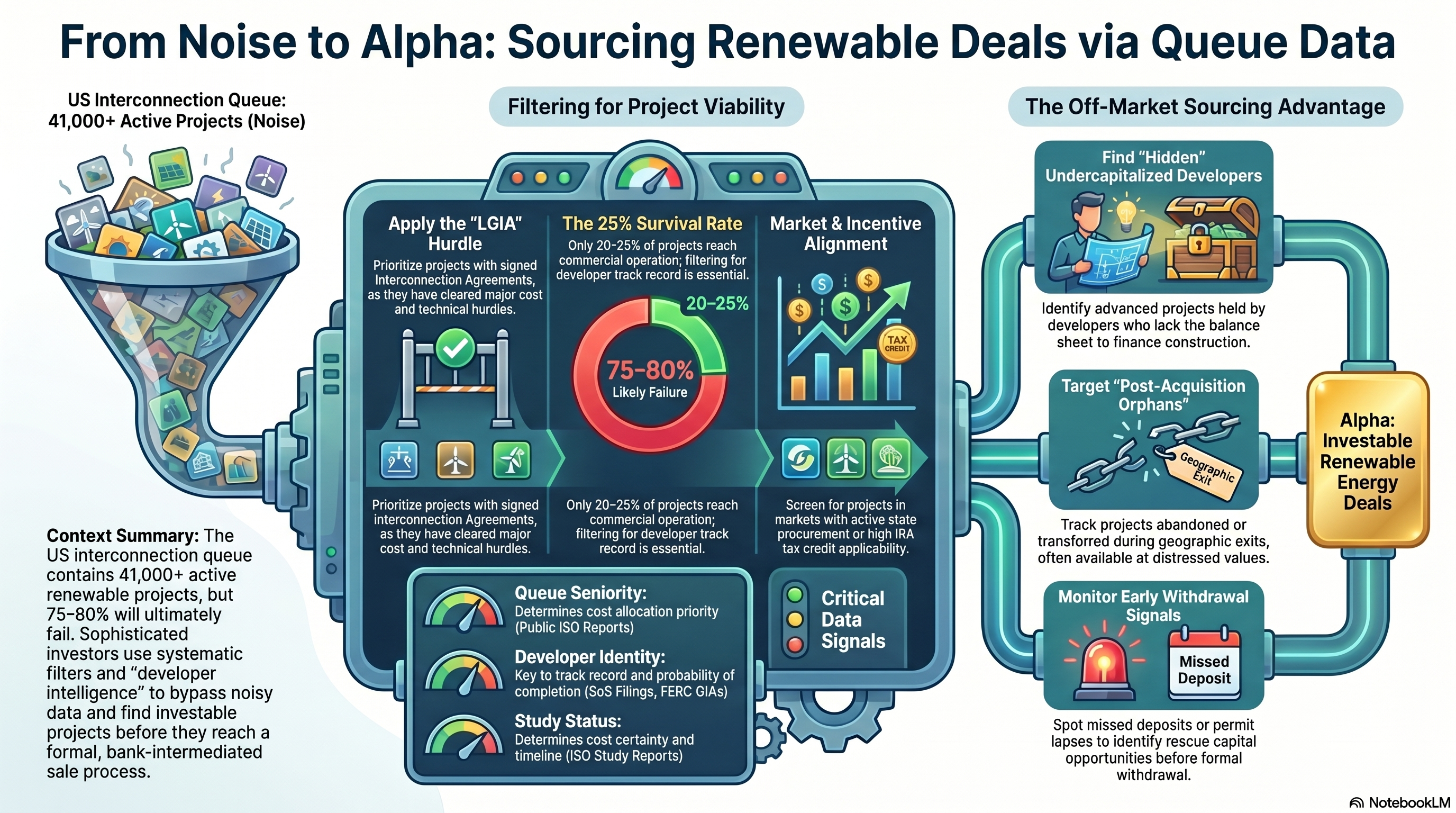
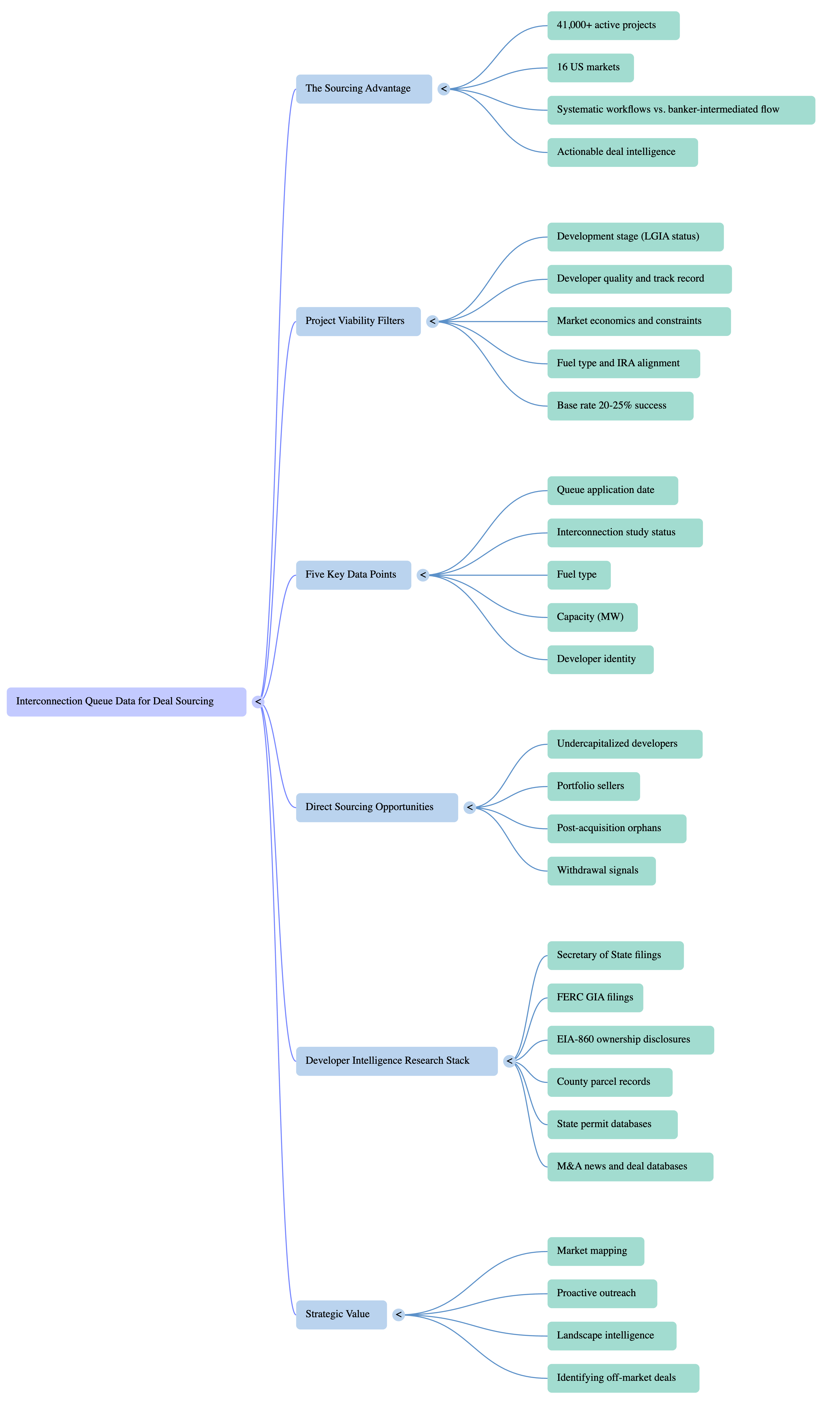
The US interconnection queue is the single largest publicly available dataset on the renewable energy project pipeline. It contains more than 41,000 active projects across 16 markets, with application dates, fuel types, capacity, project status, and — for some ISOs — developer names. Institutional investors who have built systematic workflows around this data have a sourcing advantage over competitors who rely exclusively on banker-intermediated deal flow.
That advantage is not unlimited. Queue data is noisy, often stale relative to project reality, and requires significant enrichment before it generates actionable deal intelligence. But the teams who have invested in building the underlying research infrastructure are finding and closing transactions that never appeared in a formal sale process.
The Queue as a Deal Sourcing Universe
The first step in queue-based investing is understanding what the queue actually tells you about project viability. Not all 41,000+ tracked projects are real investment opportunities. The LBNL "Queued Up" 2024 report finds that roughly 75–80% of projects that enter US queues eventually withdraw before reaching commercial operation. That means the base rate for any given queue project reaching investable status is approximately 20–25% — before adjusting for market, fuel type, developer quality, or development stage.
Experienced investors apply several filters to reduce the universe to a workable opportunity set:
- Development stage filter. Projects with signed LGIAs (Large Generator Interconnection Agreements) have completed interconnection studies, have known transmission cost obligations, and have formally committed to the interconnection queue through security posting. LGIA-signed projects have cleared a significant viability hurdle. Projects at Phase 1 feasibility study stage are much earlier and carry much higher attrition risk.
- Developer quality filter. Projects from developers with track records of reaching commercial operation are more likely to advance than projects from first-time or undercapitalized developers. Developer identification — knowing who is actually behind the queue entry — is the prerequisite for developer quality assessment.
- Market filter. Queue economics vary significantly by ISO. Projects in constrained transmission zones (certain PJM areas, parts of MISO) face higher upgrade cost risk. Projects in markets with active state procurement (Massachusetts offshore wind, California solar) have clearer offtake pathways. Market selection is embedded in any thoughtful queue-based sourcing framework.
- Fuel type filter. Solar-plus-storage in markets with IRA ITC applicability and corporate PPA demand has a different risk profile than standalone wind in a non-PTC market. Fuel type and IRA incentive alignment are basic screening variables.
The Five Queue Data Points That Actually Matter
Most US ISO queue reports publish dozens of fields per project. In practice, five data points drive most of the investment signal:
| Data Point | Why It Matters | Where to Find It |
|---|---|---|
| Queue application date | Queue seniority determines cost allocation priority and study sequencing | ISO queue reports (public) |
| Interconnection study status | Stage determines cost certainty and time to LGIA | ISO study reports; FERC eLibrary (LGIA filings) |
| Fuel type | Determines IRA incentive applicability and market revenue stack | ISO queue reports |
| Capacity (MW) | Determines project scale — minimum viable for institutional investors typically $50M+ project value | ISO queue reports |
| Developer identity | Developer track record and financial capacity determines probability of completion | SoS filings, FERC GIAs, EIA-860, parcel records, news |
Of these five, developer identity is the hardest to obtain from public queue data and the one that most differentiates sophisticated investors from less systematic competitors. Many ISOs do not publish applicant names in their public queue reports. Those that do publish names often list the SPV LLC rather than the parent developer — requiring additional research to identify who actually controls the project.
What Queue Data Reveals That Bankers Do Not Tell You
Formal sale processes (organized by investment banks, law firms, or financial advisors) present curated packages: data rooms, management presentations, and vetted buyer lists. Queue-based direct sourcing reveals what formal processes often do not:
Undercapitalized developers with advanced projects. A developer with a signed LGIA, state permits, and a strong interconnection point may lack the balance sheet to finance construction. That developer may not yet be running a sale process — but they are identifiable from queue data, SoS records, and parcel research. Proactive outreach to this developer before a formal process yields a different negotiation dynamic.
Portfolio sellers who do not know their portfolio. Regional developers who have accumulated multiple queue positions over several years often lack a clear view of their own portfolio's aggregate value. Queue data aggregated by developer name across all ISOs can reveal a developer's full portfolio — including projects they may not be actively marketing — and create the basis for a portfolio conversation.
Post-acquisition orphans. When a large developer exits a geography or segment (Eversource's 2023 offshore wind exit is a high-profile example), projects they held may be transferred to new entities that are not active developers. These orphan projects — with queue positions, parcel control, and sometimes partial permits — are frequently available at distressed values.
Withdrawal signals before they hit the queue record. Developers in financial distress often stop posting interconnection deposits, miss study milestones, or withdraw environmental permit applications before formally withdrawing from the ISO queue. Monitoring these signals — across permit databases, FERC correspondence, and developer financial news — can identify projects approaching withdrawal that are better positioned for rescue capital or acquisition.
The Developer Intelligence Layer
Queue data alone identifies a project. Developer intelligence — knowing who controls it, their track record, their financial position, and their relationship to the broader market — determines whether the project is worth pursuing.
The research stack for developer intelligence in queue-based investing typically includes:
- Secretary of State filings for the project LLC and its corporate parents
- FERC GIA filings for any executed interconnection agreements
- EIA-860 ownership disclosures for operating projects that can be used to assess developer track record
- County parcel records to verify site control and identify the specific parcel footprint
- State permit databases for air, water, and land use permits in active application
- News and deal databases for M&A history, PPA announcements, and developer financing events
Building this research stack systematically — across 41,000+ queue projects (withdrawn included) and 16 ISOs — is the core infrastructure challenge that separates institutional-quality queue analysis from ad hoc project research.
Why This Matters for Developers and Investors
For developers, the existence of queue-based investor research changes the outreach landscape. Investors who have built systematic queue intelligence capabilities are proactively identifying and contacting developers whose projects match their investment criteria — without waiting for a formal sale process. Developers who have made themselves visible through queue data (by having identifiable developer names in queue records, maintaining updated SoS registrations, and keeping EIA records current) are more likely to receive inbound investor interest.
For investors entering or expanding in the renewable energy space, the queue is the starting point for market mapping — understanding which developers are active in which markets, at what development stage, and with what project pipeline. Systematic queue analysis replaces the conference circuit as the primary landscape intelligence tool.
Conclusion
The interconnection queue is the most comprehensive public dataset on the US renewable energy project pipeline. Investors who treat it as a systematic sourcing input — rather than background market context — are identifying deals that do not appear through traditional channels. The bottleneck is developer identification: knowing who is behind each queue entry is the research challenge that determines how much signal the queue data actually delivers.
For the county-level geographic concentration data that informs market selection, see County-Level Renewable Energy Concentration in US Queues. For the withdrawal-rate data that calibrates queue project probability estimates, see Interconnection Queue Withdrawal Rates: What Withdrawn Projects Reveal.
Load Factor provides the developer intelligence layer on top of queue data — identifying the developers behind the 41,000+ queue projects it tracks, withdrawn included, wherever the public record names them. Sign in to access developer attribution, evidence chains, and portfolio analysis.