While the interconnection queue absorbs the industry's attention, a second procurement market has been quietly assembling underneath it. Utilities across 49 US states and territories are currently running 431 grid flexibility programs, 422 of them open, from 190 distinct buyers.
Almost none of it shows up in queue data, because almost none of it requires an interconnection request.
Where the programs are
| State | Programs | Distinct buyers |
|---|---|---|
| California | 108 | 40 |
| Tennessee | 29 | 13 |
| New York | 27 | 8 |
| Texas | 21 | 15 |
| Connecticut | 16 | 2 |
| Kentucky | 11 | 4 |
| New Jersey | 11 | 4 |
| Indiana | 10 | 5 |
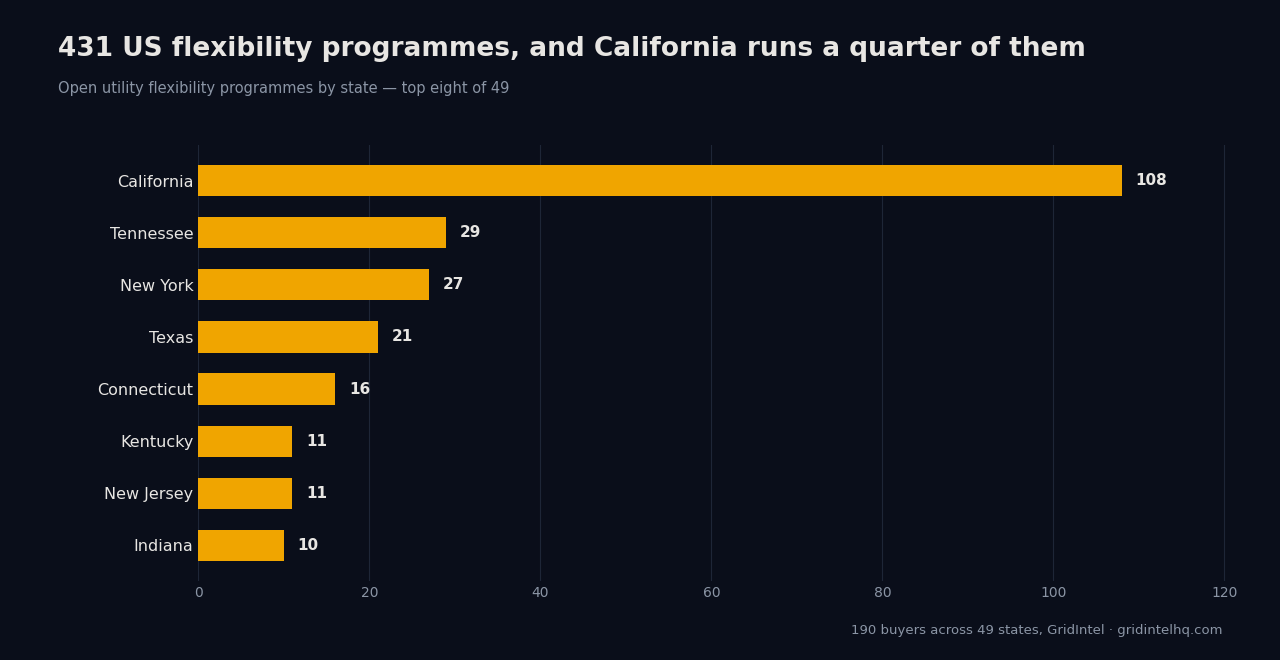
California accounts for a quarter of the national total on its own, spread across 40 separate buyers — a fragmented market rather than one or two large schemes. Tennessee and Kentucky appearing this high is the surprise; neither is where most people would look for a flexibility market.
This is a demand-side market
What these programs actually procure separates them sharply from generation:
| Service procured | Programs |
|---|---|
| Load reduction | 437 |
| Resource adequacy | 45 |
| Load reduction and load increase | 21 |
| Load increase | 2 |
Load reduction dominates. These utilities are not buying megawatts — they are buying the ability to not need megawatts at a specific hour. That is a fundamentally different product with a different cost structure and a different counterparty.
The eligibility rules confirm it. Of the US programs, 297 accept commercial and industrial participants and 221 accept residential, whether directly or through an aggregator. Only 48 accept front-of-meter assets.
Read that ratio again. Roughly six times as many programs are open to a building owner or an aggregator as are open to a grid-scale generator. Utility-scale developers are, for the most part, not the intended participant here.
Why it is invisible
A behind-the-meter battery enrolling in a demand response program does not file an interconnection request. It does not appear in an ISO queue, an EIA-860 filing, or a FERC docket. The entire market sits in a blind spot for anyone whose view of the grid is assembled from those sources — which is most of the industry, including most of this publication's usual subject matter.
The programs are public. They are simply published one utility at a time, in whatever format that utility chose, with no central register. Which is why 431 concurrent programs can run across 49 states without anyone having a number for it.
Who this matters to
If you own or aggregate distributed assets, this is 422 open procurement routes that require no queue position and no interconnection study — a materially shorter path to revenue than anything on the generation side.
If you develop utility-scale, the relevance is indirect but real: every megawatt of load a utility can shed at peak is a megawatt of capacity it does not need to procure. Flexibility procurement competes with generation procurement for the same resource adequacy need.
And if you sell to utilities, 190 distinct buyers are running these programs — a fragmented, under-mapped buyer set, which is usually where the opportunity is.
Based on Load Factor's flexibility programme dataset: 431 US programmes from 190 buyers across 49 states, with eligibility and service type as published by each buyer. Programme counts by service type exceed the programme total because some procure more than one service.